Village History
Memories of Huggate: An Oral History
We have collected an oral history of Huggate, promoting intergenerational awareness and collaboration. A series of interviews with older residents allowed us to develop a picture of how village life has changed in the last century and inspire the younger members of the community to continue the guardianship of the Church and heritage.
There were huge changes in rural life during the twentieth century, because of the mechanisation of agriculture. The Huggate memories project aimed to find out how this impacted the lives of villagers by recording conversations with people who have lived within the parish.
These conversations have been transcribed and collected into an account of some personal experiences of living in Huggate and on its surrounding farms and how the village itself has changed within their lifetimes.
The project can carry on for as long as people are willing to share their stories.
The collection is available in St Mary’s Church, Huggate and the Village Trail.
How far back did we go?
My conversations took us back to the 1940s in the lived experience of Huggate people. However, as we chatted and looked together at some of the early old photographs we had been given, stories told by parents and grandparents were remembered. Through this we have gained glimpses of life over a hundred years ago, when the parish population was 463 (compared with 313 in 2021) and half of the land was owned by William Jessop, a steelworks tycoon from Sheffield.
A Taste of some of our stories
The Cooper Family
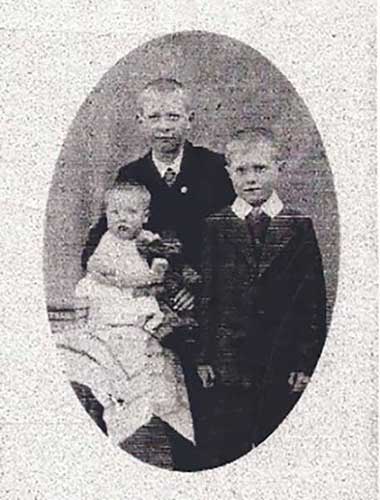
Here are three brothers born between 1910 and 1918. Their father was a blacksmith; there were at least two in the village in addition to any employed directly on farms.
Francis pictured on the right died the next year, aged 12 while helping in the fields at harvest. The family story says he was kicked in the head by a horse startled by the firing of a gun.
The Witty Family
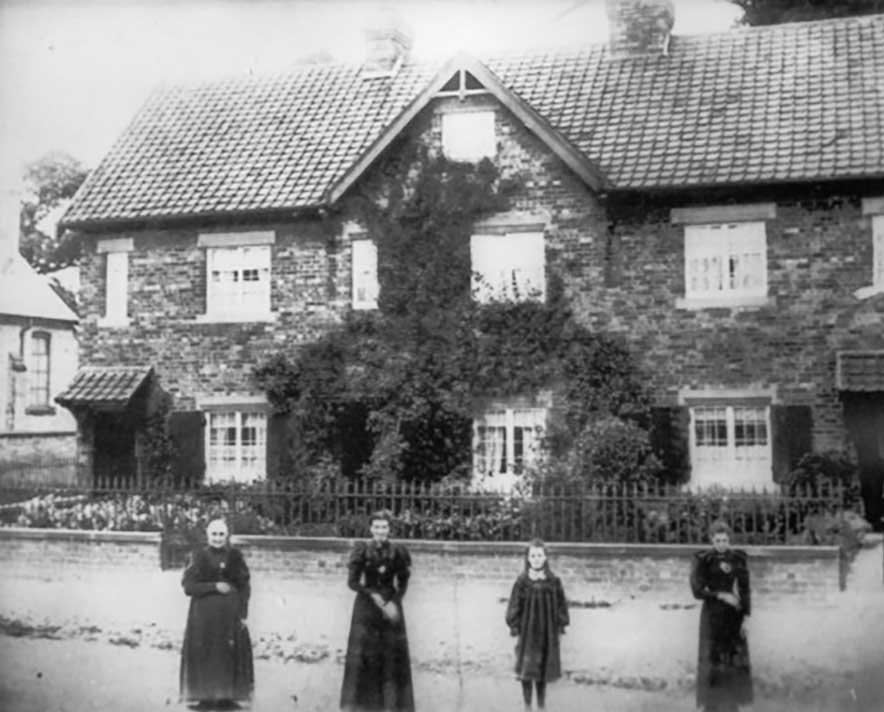
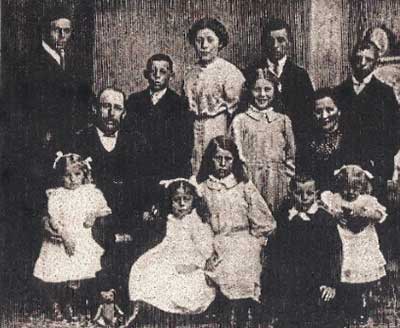
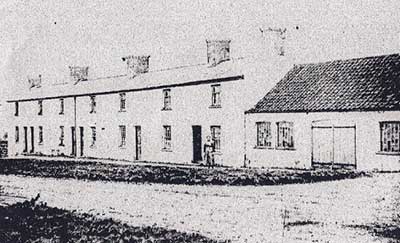
Here are Mr and Mrs Witty with 11 of their children born between1896 and 1914; were there any more? Everyone I spoke to about these cottages said “ The Witty’s – they were a big family”. So, they have clearly gone down in village history. They ran a carrier’s business from Northview Cottages, aka Witty Row, pictured here.
I was told that it cost 2/- (10p) to go to go on their bus to Driffield on a Thursday in the 1930s/40s. Can it really have been that expensive? A little research suggests that at this time 2/- would buy 2-3lbs bacon or 20 bottles of beer and that a farm worker would earn about 30/- per week.The vehicle used a bus to market in Driffield on a Thursday was used as a cattle truck for the rest of the time.
Blythe’s Pond
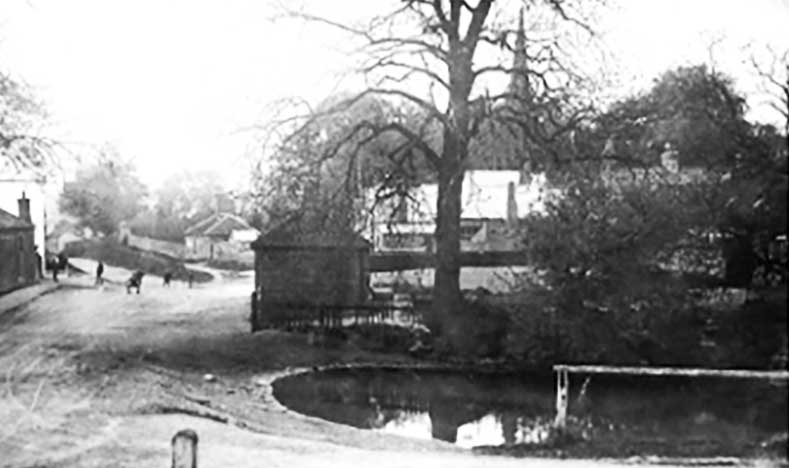
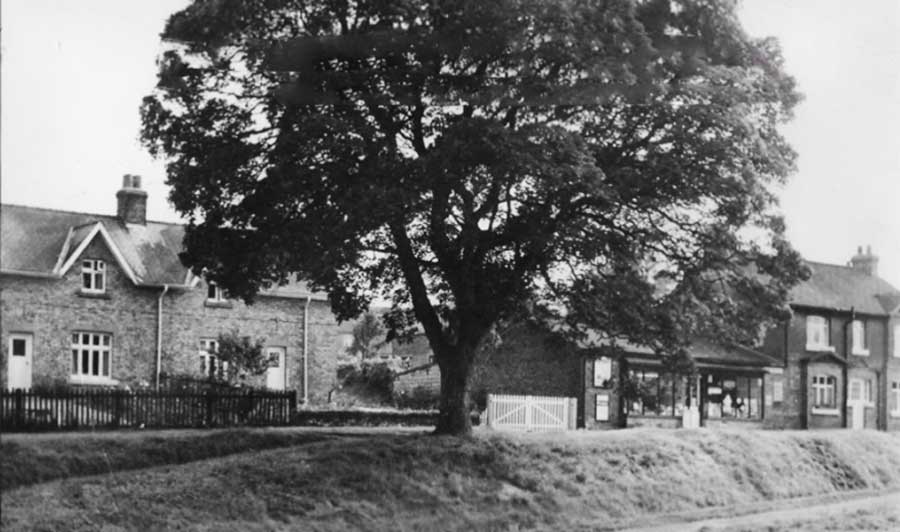
This photograph was taken around 1910. The building almost hidden behind the trees on the right was the blacksmith’s shop run by James Cooper. The little building in the middle of the picture was a carpenter’s shop. The carpenter was HT Daniel.
At this time villagers took their water from their own cisterns or, if they had to, from the ponds. There was a well, dug in the 18th century but at 103.4m (339ft) deep, it was impractical. Apparently, it took 2 men over twenty minutes to raise a bucket of water Mains water didn’t come to the village until just before World War II and then it was to outside taps shared between several houses; not plumbed into homes.
This part of the village looks totally different now as the pond has been filled in, the workshops are no more and a house has been built on the site.
The Mere
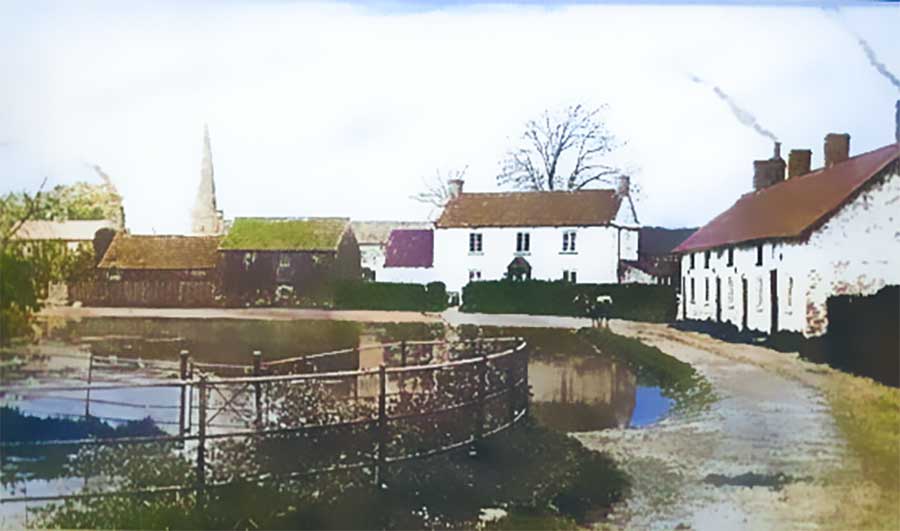
At the farm beyond The Mere: The Mar Pond a baby girl was born in 1938. She was very premature and only weighed as much as a bag of sugar around 2lbs or 1kg. The doctor said she wouldn’t survive, but her grandma didn’t give up. She gave her drips of brandy from a tiny dropper! Miraculously the baby survived and grew up. She became part of the cup winning ladies cricket team of the 1950s!
In the middle of the twentieth century the farm in this picture housed the village fish and chip shop! The farmer brought the fish in on his horse and trap along with post (probably parcels) all on top of coal for the stove!
The chalk- built cottages to the right of the picture aren’t here any more. It seems people moved out, they became derelict and then, a local farmer took it into his head to come along and bull-dozed them down! Traces of their foundations can be found in the front gardens of two much more modern bungalows.
The School
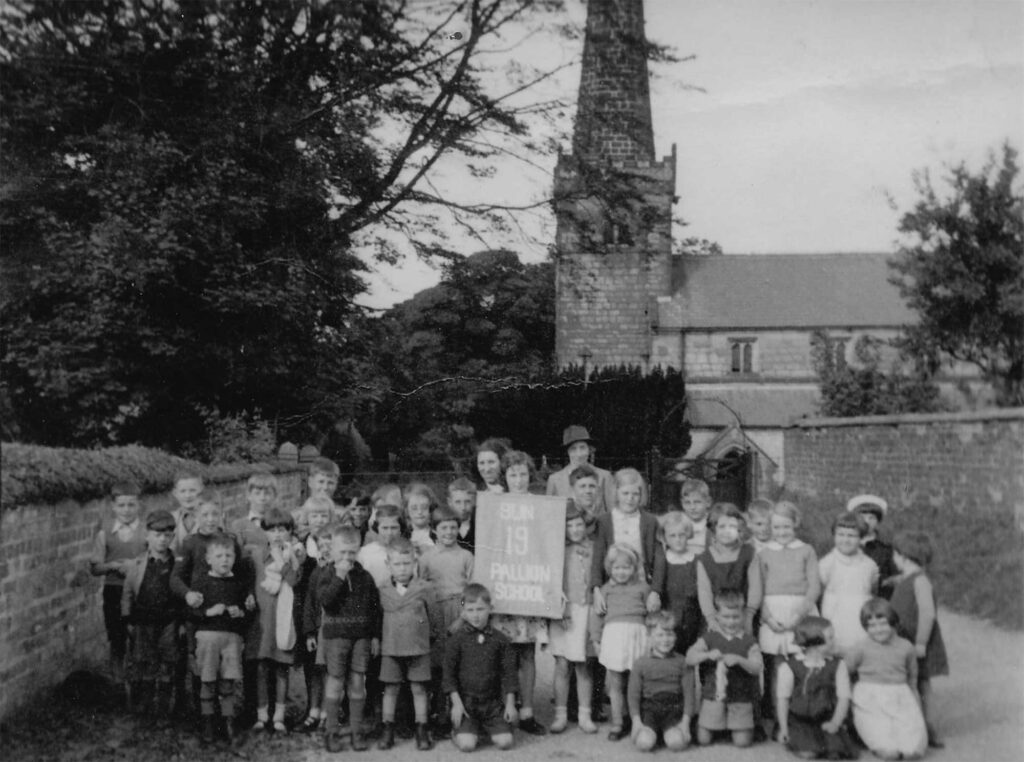
The change in demographic of the village is illustrated beautifully by its school Built around 1846 it replaced a private school in one of the village homes. The new school for all the children was next to and closely linked to the church and its parson. Photos from the turn of the 20th century suggest an attendance of about 80 pupils; By the middle of the century this had dropped to around 30 and when the school closed in 1959 about a dozen.
During the second world war the school was shared with evacuee children. Individual evacuees came from Leeds and Hull, but a large group came from Pallion School in Sunderland. The children had to share the school so both groups only had half a day of lessons!
Everyone I spoke to had happy memories of school. Mr Cass seems to have been the Head teacher for a long time. There were two classes, in two rooms covering the Elementary or Primary years of schooling. After the 1948 Education Act children went by bus to Pocklington from the age of 11.
The Village Store
For many years Huggate had a village shop and Post Office and for some time until the middle of the last century there was another shop run by Mrs Daniels at the bottom of the village, where people remember going for sweets when they were children.
The shop in this picture was a very well stocked general store run by at least two generations of the Hoggard family. It was also a telegraph office and the children could earn as much as 9d or 1s 6d for cycling with a telegram, sometimes as far as an 8-mile round trip!
The shop sold everything people needed including the paraffin vital for the lamps that lit all the houses; electricity didn’t come to the village until 1948.
It was also common for traders from the towns to take orders and deliver all manner of shopping: from groceries to haberdashery.
Sadly, the shop closed in the early1990s.
Huggate - On top of the Wolds
Yorkshire Times May 15, 1953
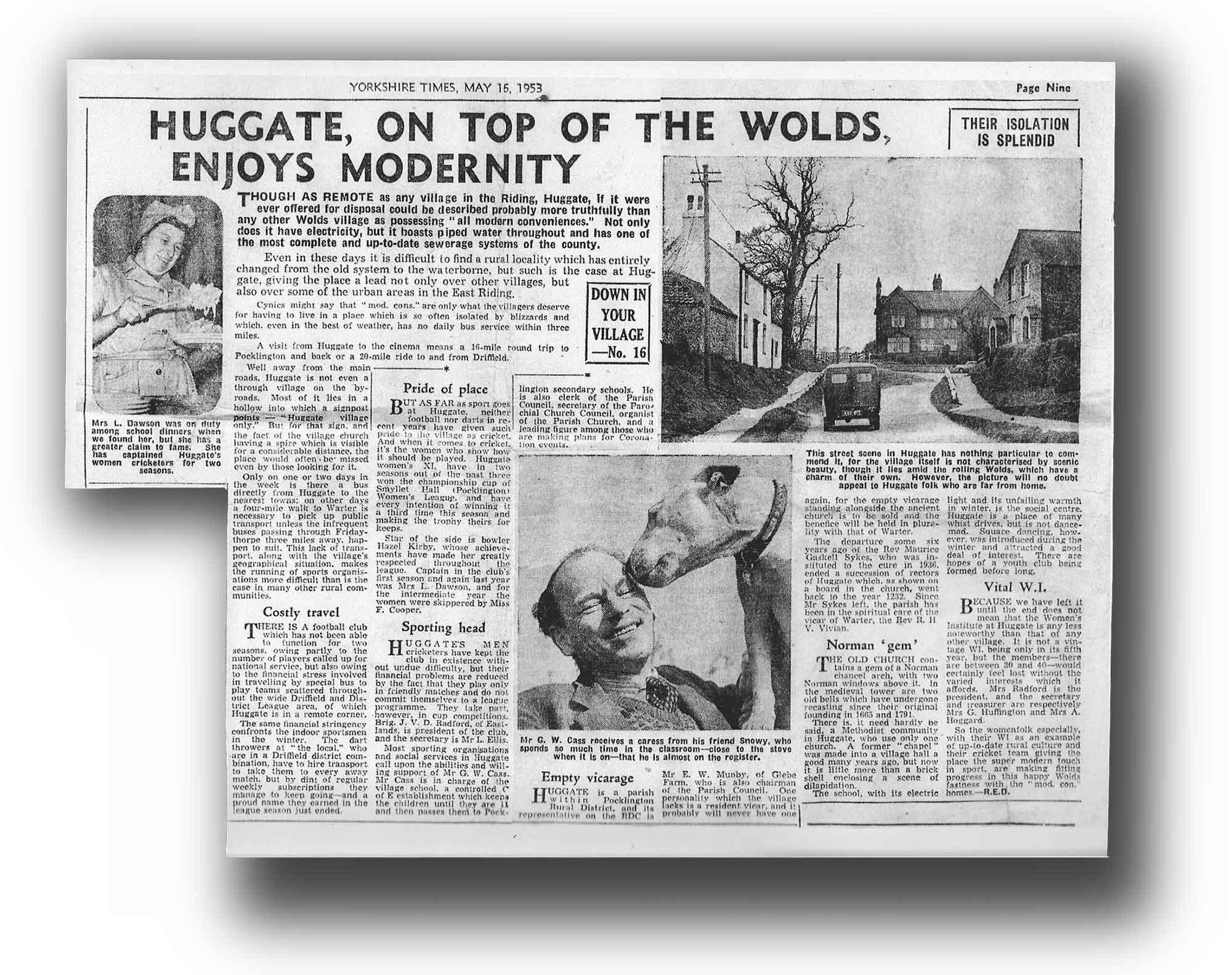
Though as remote as any village in the Riding, Huggate. If it were ever offered for disposal could be described probably more truthfully than any other Wolds village as possessing all modern conveniences”. Not only does it have electricity, but boasts piped water throughout and has one of the most it complete and up-to date sewerage systems of the county.
Even in these days it is difficult to find a rural locality which has entirely changed from the old system to the waterborne, but such is the case at Huggate, giving the place a lead not only over other villages, but also over some urban areas in the East Riding.
Cynics might say that “mod cons” are only what the villagers deserve for having to live in a place which is often isolated by blizzards and which even in the best of weather has no daily bus service within three miles.A visit to the cinema means a 16- mile round trip to Pocklington and back or a 20-mile ride to and from Driffield.
Well away from the main roads, Huggate is not even a through village on the by-roads. Most of it lies in a hollow into which a signpost points “Huggate Village Only”. But for that sign and the fact of the village church having a spire which is visible for a considerable distance, the place would often be missed even for those looking for it.
Only one or two days in a week is there a bus directly from Huggate to the nearest towns; on other days a four-mile walk to Warter is necessary to pick up a public transport unless the infrequent buses passing Fridaythorpe three miles away, happens to suit. This lack of transport, along with the village’s geographical situation makes the running of sports organisations more difficult than is the case in many other rural communities.
Costly Travel
Tere is a football club that has not been able to function for two seasons, owing partly to the number of players called up for national service, but also owing to the financial stress involved in travelling by special bus to play teams scattered throughout the wide Driffield and District League area of which Huggate is in a remote corner.
The same financial stringency confronts the indoor sportsmen in the winter. The darts throwers at “the local” who are in a Driffield District combination have to hire transport to take them to every away match, but by dint of regular weekly subscriptions they manage to keep going and a proud name they have earned in the league season just ended.
Pride of Place
But as far a sport goes at Huggate neither football nor darts in recent years have given such pride to the village as cricket. And when it comes to cricket it’s the women, who show how it should be played. Huggate Women’s XI have in two seasons out of the last three won the championship cup of Smyllet Hall Pocklington Women’s League and have every intention of winning it a third time this season and making the trophy theirs for keeps.
Star of the side is bowler Hazel Kirby, whose achievements have made her greatly respected throughout the league. Captain of the club’s first season and again last year was Mrs L Dawson (photo top left on duty among school dinners) and for the intermediate year the women were skippered by Mrs F Cooper.
Sporting Head
Huggate’s men cricketers have kept the club in existence without undue difficulty, but their financial problems are reduced by the fact that they play only in friendly matches and so not commit themselves to a league programme. They take part however in cup competitions. Brig.J.V.D. Radford of Eastlands is president of the club and the secretary is the Mr I. EllisMost sporting organisations and social services in Huggate call upon the abilities and willing support of Mr. G.W. Cass (Middle picture of Mr Cass receiving a caress from his friend Snowy, who spends so much time in the classroom- close to the stove when it is on that he is almost on the register). Mr Cass in charge of the village school, a controlled C of E establishment which keeps the children until they are 11 and then passes them to Pocklington secondary schools. He is also clerk of the Parish Council, Secretary of the Parochial Church Council, organist of the Parish Church and a leading figure among those who are making plans for the Coronation events.
Empty Vicarage
Huggate is a Parish within Pocklington Rural District, and its representative on the BBC is Mr. E. W. Mumby of Glebe farm, who is also chairman of the Parish Council. One personality that the village lacks is a vicar and will probably never have one again, for the empty vicarage standing alongside the ancient church is to be sold and the benefice will be held in plurality with that of Warter.The departure some six years ago, of the Revd. Maurice Gaskell Sykes who was instituted to the cure in 1936 ended a succession of rectors of Huggate which, as shown on the board in the church, went back to the year 1232. Since Mr Sykes left, the parish has been in the spiritual care of the vicar at Warter, the Revd. R.H. V. Vivian.
Norman ‘Gem’
The old church contains a gem of a Norman chancel arch, with two Norman windows above it. In the medieval tower are two old bells which have undergone recasting since their original founding in 1663 and 1701.There is, it need hardly be said a Methodist community in Huggate, who use only one church. A former “chapel” was made into a village hall a good many years ago, but now it is little more than a brick shell, enclosing a scene of dilapidation.
The school with its electric light and its unfailing warmth in winter is the social centre. Huggate is a place of many whist drives, but it is not dance-mad. Square dancing, however was introduced during the winter and attracted a good deal of interest. There are hopes of a youth club being formed before long.
Vital W.I.
Because we have left it to the end does not mean that the Women’s Institute at Huggate is any less noteworthy than that of any other village. It is not Vintage W.I. being only in its fifth year, but the members- there are between 30 and 40 would certainly feel lost without the varied interests which it affords. Mrs Radford is the president and the secretary and treasurer are respectively Mrs G. Huffington and Mrs A Hoggard.
So the womenfolk especially with their W.I. as an example of up-to-date rural culture and their cricket team giving the place the super modern touch in sport are making fitting progress in this happy Wolds fastness with the “mod con” homes. R.E.D.
Top Right Picture: This street scene in Huggate has nothing particular to commend itself, for the village itself is not characterised by scenic beauty, though it lies amid the rolling Wolds, which have a charm of their own. However, the pictures will no doubt appeal to Huggate folk who are far from home.
Plane crashes into holiday school
The Daily Mail
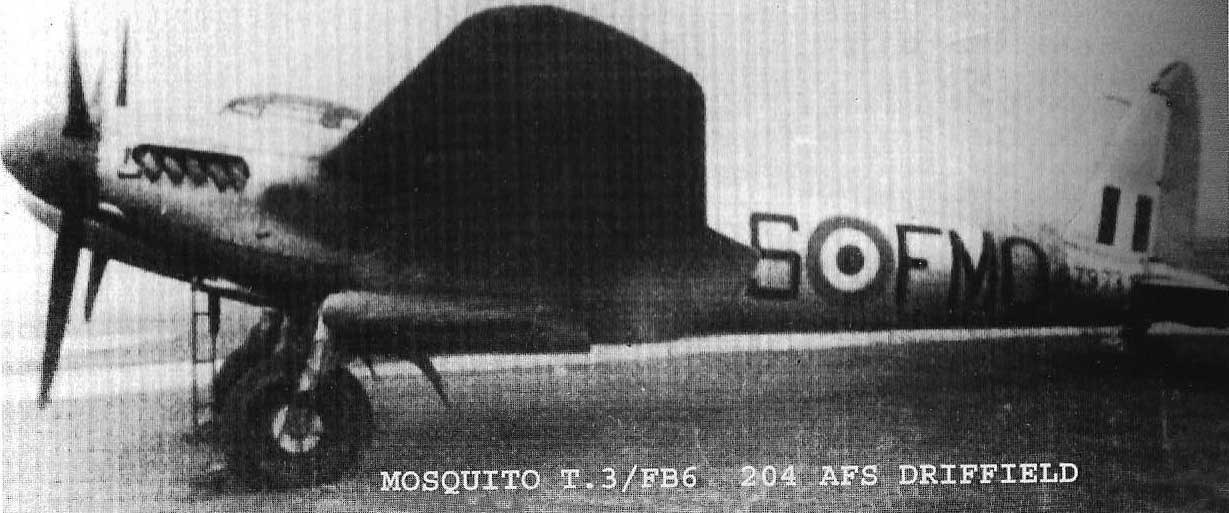
On the 8th March 1049 a MOSQUITO T3/FB6 NoRR 298 from the 204 AFS (Advanced Flying School) Driffield suffered structural failure while attempting to pull out of a dive over Huggate. The plane broke up in the air. Parts of the aircraft crashed into Huggate School.
At 12.10pm every schoolday the playground of the tiny village school in Huggate 700ft high up on the Yorkshire Wolds, near Pocklington is full of laughing children just released from lessons – except on one day of their 200schooldays a year – yesterday was that day.
Reason: The scholarship examinations for local high school entry were being held and all except four of the thirty-four Huggate School children had a day’s holiday.
At 12.10 yesterday a Mosquito plane flying over the village exploded. It dived into a nearby field, killing the pilot20 year-old Michael Brenton Birks.The petrol tank crashed through the roof of the school porch, demolishing it in a mass of slates and tiles.
Eleven-year-old Patricia Cass daughter of the village schoolmaster was just leaving school with her mother after completing the morning examination session when the school was hit.
Mrs Cass clutched her daughter protectively as the porch collapsed and her arm was injured. Patricia was taken to hospital with a badly cut leg.
“On a normal day children would have been released from class only a few minutes before and many of them would have been playing in the porch and in the yard.” Said Mrs Cass“
The other examination entrants all aged 12 had gone home.”“Pat and I heard the plane flying low. Then there was a terrific explosion and the petrol tank crashed through the roof and fell within inches of us and burying itself in the ground.
EXPLOSION
“Pat and I were soaked with petrol and it flooded the classroom.”John Blyth, 14 year-old Boy Scout who saw the plane explode and one man bale out, told me:-
“The man jumped as the plane flew very low and the parachute opened only when he was about 30ft form the ground. He fell heavily cutting his hands and face, but he staggered to the blazing wreckage.
”The airman, Flying Officer Anthony Archibald Smailes of Driffield Aerodrome, an instructor, found poultry farmer Fred Germaine already there.”“A man was lying in the wreckage which was burning fiercely.” said Mr Germaine. “I crawled forward, caught his legs and pulled him clear, but he was dead.
”It was only then that Flying Officer would have his injuries attended to. He is thought to have fractured his collar bone.
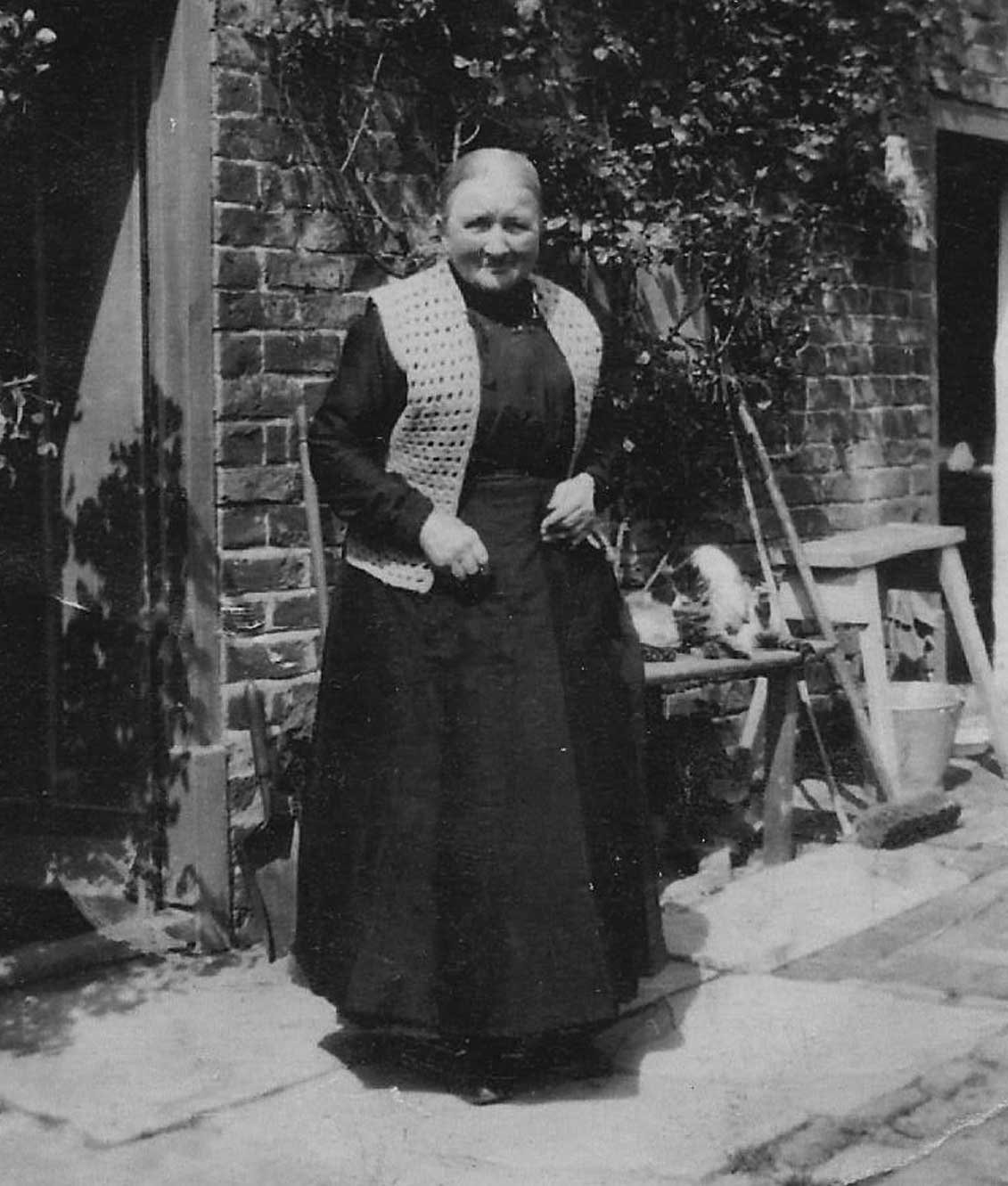
Mrs Walker outside Church View Cottages
The Hull Times 1930
Mrs Walker lives in a cottage facing the church, and close to the tumble-down building of stone from the Wolds where she went to school. She belongs to a Huggate Family.
A rosy-faced old woman is Mrs Walker, quite active and well for her eighty-five years, and enjoys reading about “Our Folk” whom she knows and recognises in the Hull and Yorkshire Times, which is lying on her kitchen table. She went to ‘placing’ as a girl and was at Huggate Wold at Mr Byass’ and at Mr Thomas Alison’s in Huggate village. I admired the “pot dogs” black and white spaniels they were, which sat complacently on the high mantlepiece and Mrs walker told me she had bought them herself when she was in ‘placing’.
Thomas Hoggard loves next door to Mrs Walker and is not only a neighbour, but a connection by marriage. He is eighty-two years old and came from Kilham and on front of his for twenty-three years was the estate builder for Mr Jessop, who at one time owned much land in Huggate.
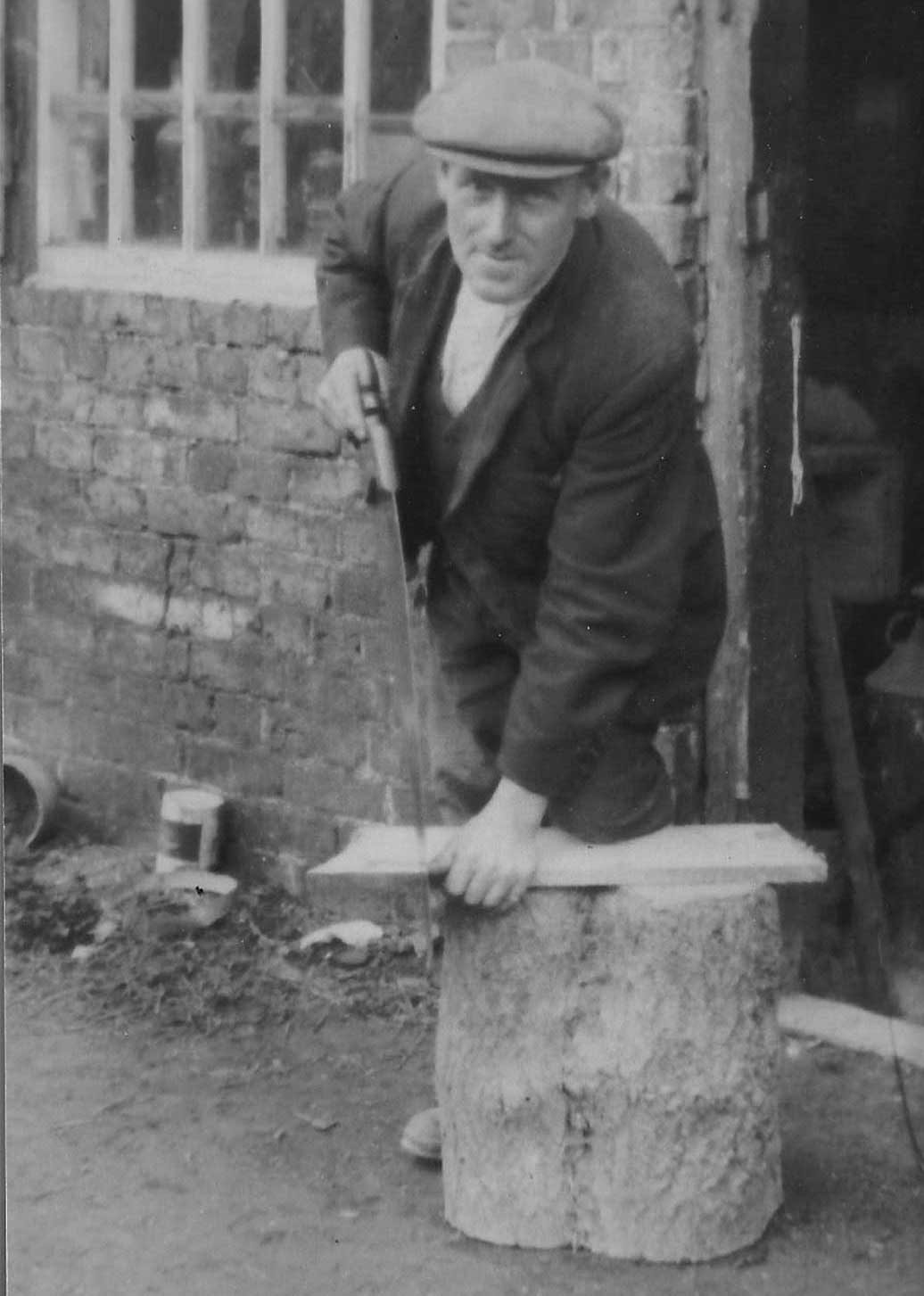
Mr Thomas Daniel outside the Carpenter's shop
May was sunny and benign the way to spent among the wide spaces of the Wolds at Huggate, so no wonder I found Thomas Daniel working in the well-kept garden in front of his red-roofed house. He had been the estate joiner for Mr Jessop, when that person owned most of Huggate; he had bought that very pleasant house, and had retired form active business, leaving his son to carry on his place as the village
Out there by his tiny plantation of firs and close to his masses of purple aubretia, or ‘blue rock ’as the villagers call this spring rock plant, he told me that he was born at Riccall and had been apprenticed in Skipwith. He had been a keen cricketer in those days and showed me, with pardonable pride the beautiful presentation bat which had been ‘presented to HT Daniel, by Skipwith Cricket Club, October 27th 1874’ looking well-oiled and in as good condition as though it had never been used. It had indeed been used twice, for Thomas Daniel had not wished to waste it in any way. Once he had n=made sixty-two runs not out, with it and the second time he had made thirty-seven runs and was out. He had played against County players Harry Duce and Roger Iddeson, of York, in his time. He had been to Bridlington to play cricket six times and five times his team and won. The treasured bat was a prize for the biggest bowling average as well as the biggest batting average. Thomas Daniel had headed the list for both, that year, but as he could hardly take two bats he had handed the second one to the next best cricketer. He seems as happy as the day is long. He thinks that this is a grand country.