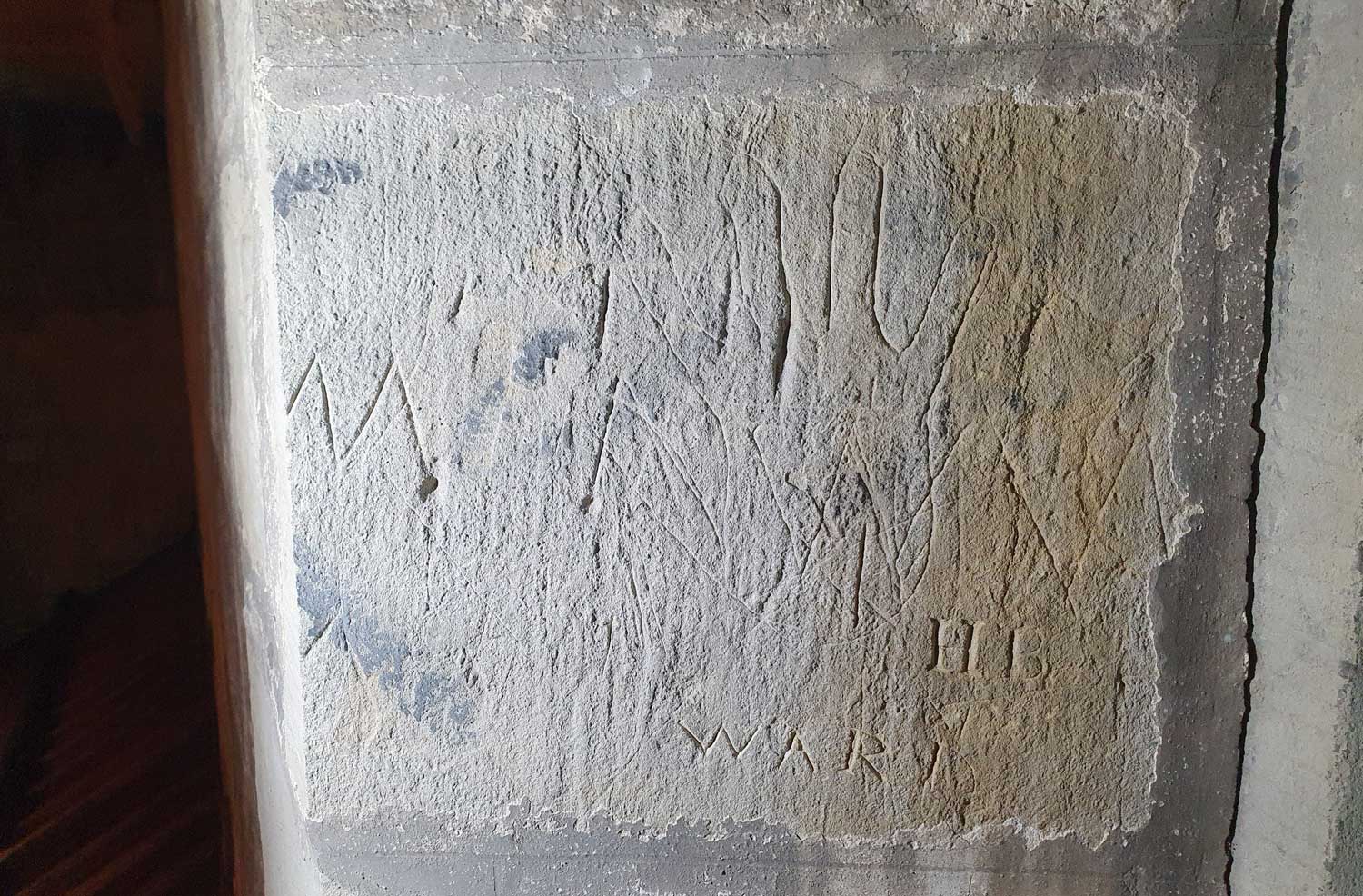
As part of the Heritage Lottery funding awarded to the church of St Mary, Huggate, we are carrying out a project to identify distinct and historical marks, ‘Mysterious marks’
Graffiti or apotropaic (averting evil) marks can be found on the walls, both inside and on the outside of St Mary’s. For a small church it is surprising how varied these marks are with their creation possibly spanning the lifetime of the church.
“Commonly known as ‘ritual protection marks’ or even ‘witches marks’ an apotropaic image or symbol is a marking that is thought to create protection” Matthew Champion from Mediaeval Graffiti.
Over the last few decades much interest has arisen into historic graffiti. Who were the authors? What were their messages, how did they create the markings? Little attempt had been made to record or preserve these reflections of lives lived over the centuries. The freeing up of the interior space in St Mary’s, by removing the pews, has allowed for a new examination of the space.
We are currently going through the process of locating and recording the marks found around St Mary’s. In time we also hope to interpret and make sense of some of them. Some of the areas they are located in are prone to damp and weathering so their preservation is also an issue.
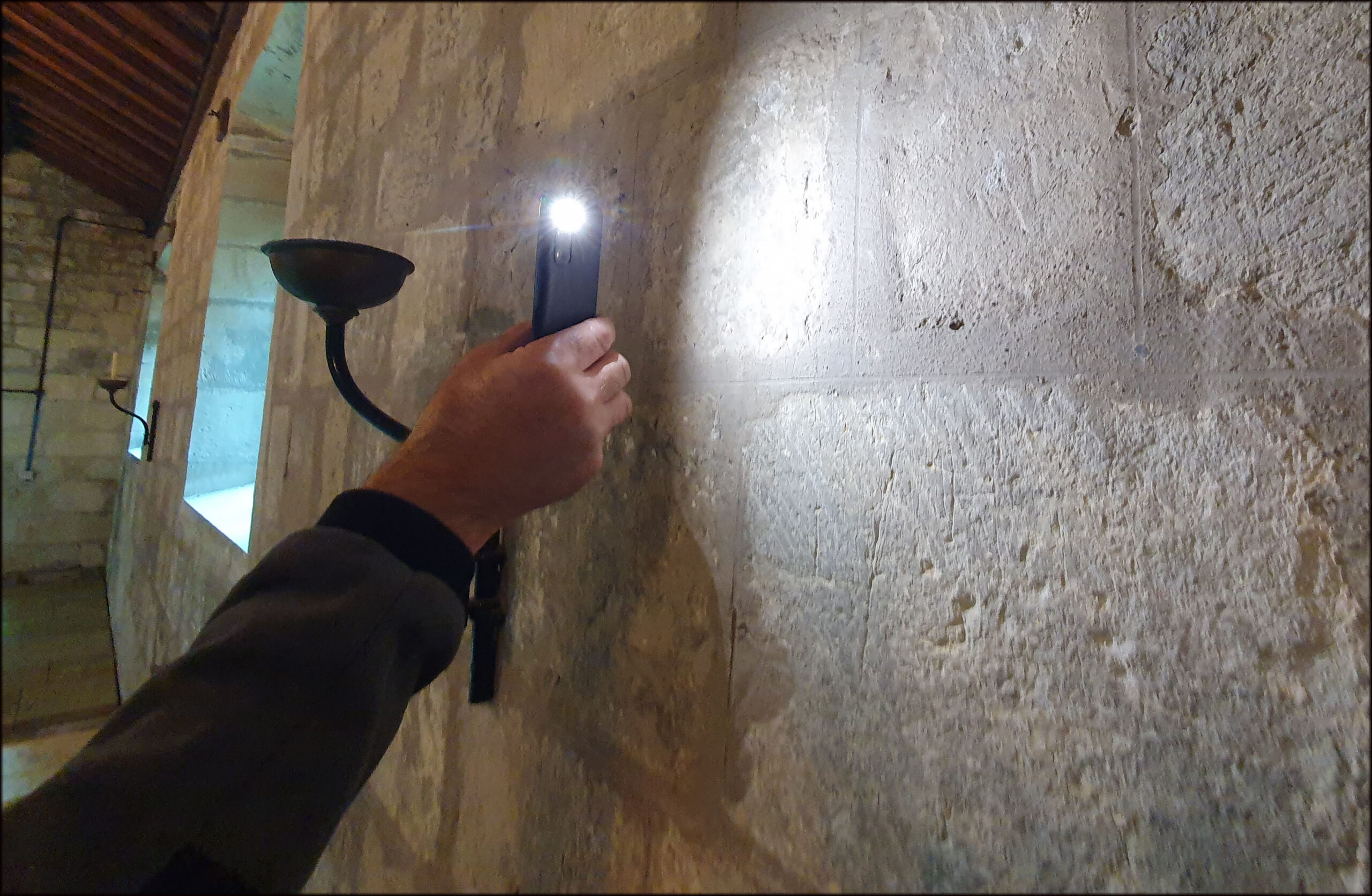
Please help us locate the marks on the walls. Once you get your eye in you will find it difficult to visit an older building without having the urge to investigate the walls for marks. We are still finding new ones, when the quality of light changes across the wall and in different seasons, when the sun’s rays fall at different angles, marks are revealed. Searching for the marks can be aided by shinning a raking light across the surface of the stone. The light from a mobile phone is handy for this.
St Mary’s has had its fair share of alterations, (the recent archaeological survey has identified at least 4 distinct phases of construction, repair and refurbishment from the early medieval to the Victorian era). Always with the best of intentions but from the perspective of studying the graffiti it is more than likely that the Victorians erased much in their pursuit of their idea of perfection.
For many people the term ‘graffiti’ has negative connotations, however the practice has not always had negative and undesirable, indeed it may have in the past been sanctioned within the church setting.
In recent years there has been an increasing interest in recording the marks on church walls and other historic buildings. Themes and patterns have been identified repeating across parishes and counties.
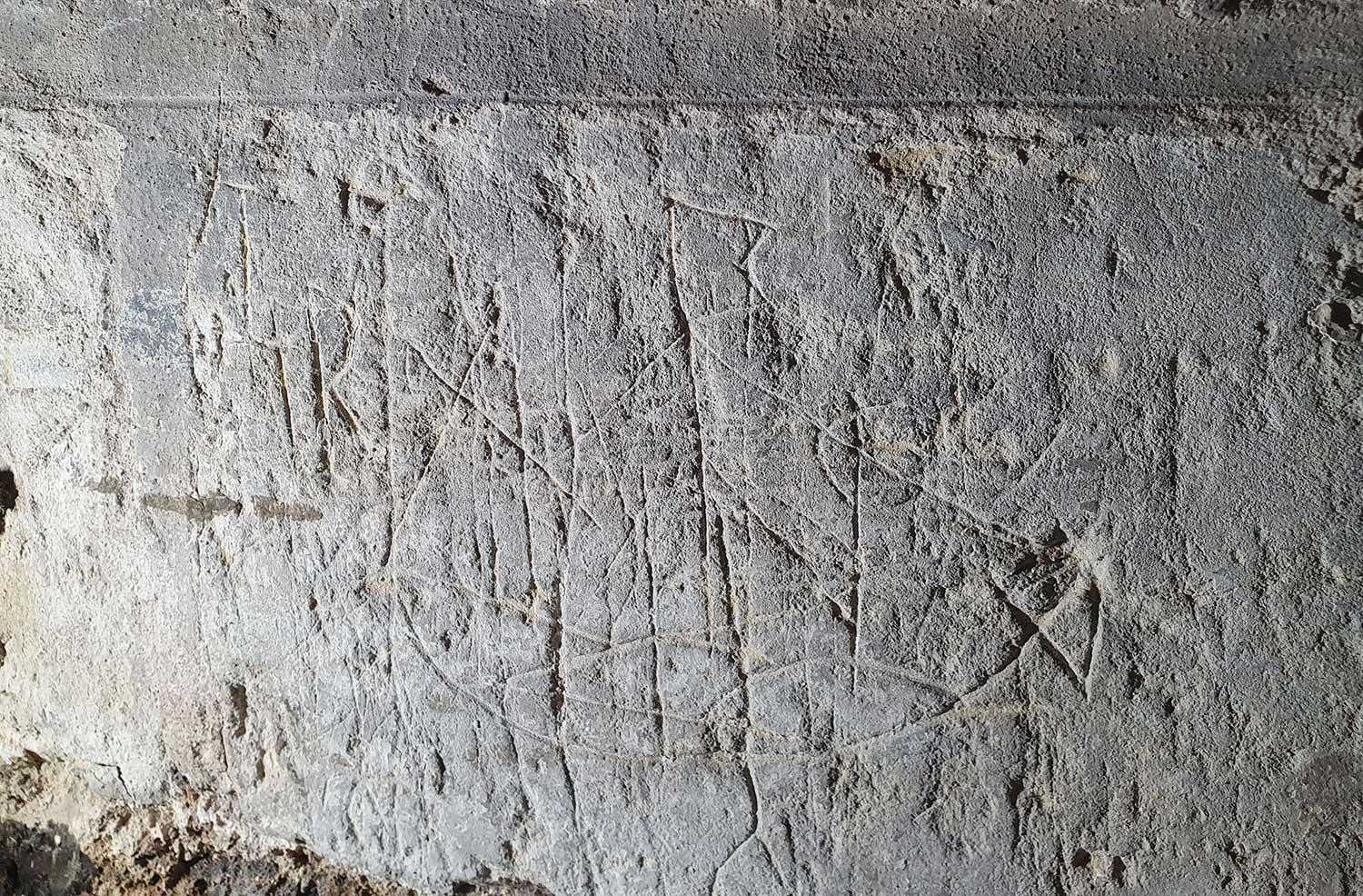
Ship graffiti is a recurring image, especially prevalent in churches located in coastal regions. Whitby parish documents over 40. To find one in Huggate was a thrill and raises a number of questions as to its historical significance. (picture 2)
Was the ship drawn by a local mariner before returning to sea or drawn by a relative praying for a safe return. The style of the ship can give a clue to the era it was drawn in.
The location of the ship, drawn on the lower course of stone on the south aisle, may not be in its original location, but a consequence of the Victorians reordering in 1864. Which begs the question, were there more marked stones which have been reused in a different orientation, obscuring the marks. This may be the case on the window casement in the north aisle where the marked stone is set upside down with a W truncated where the stone has possibly been reworked. (picture 3)
“Graffiti brings to life the ordinary, the illiterate and the every day, so often excluded from historical accounts. It shows us what concerned people, how they felt about themselves and the innate need to be remembered”.
Pamela Devine, writing on Shakespear’s walls.
picture 2